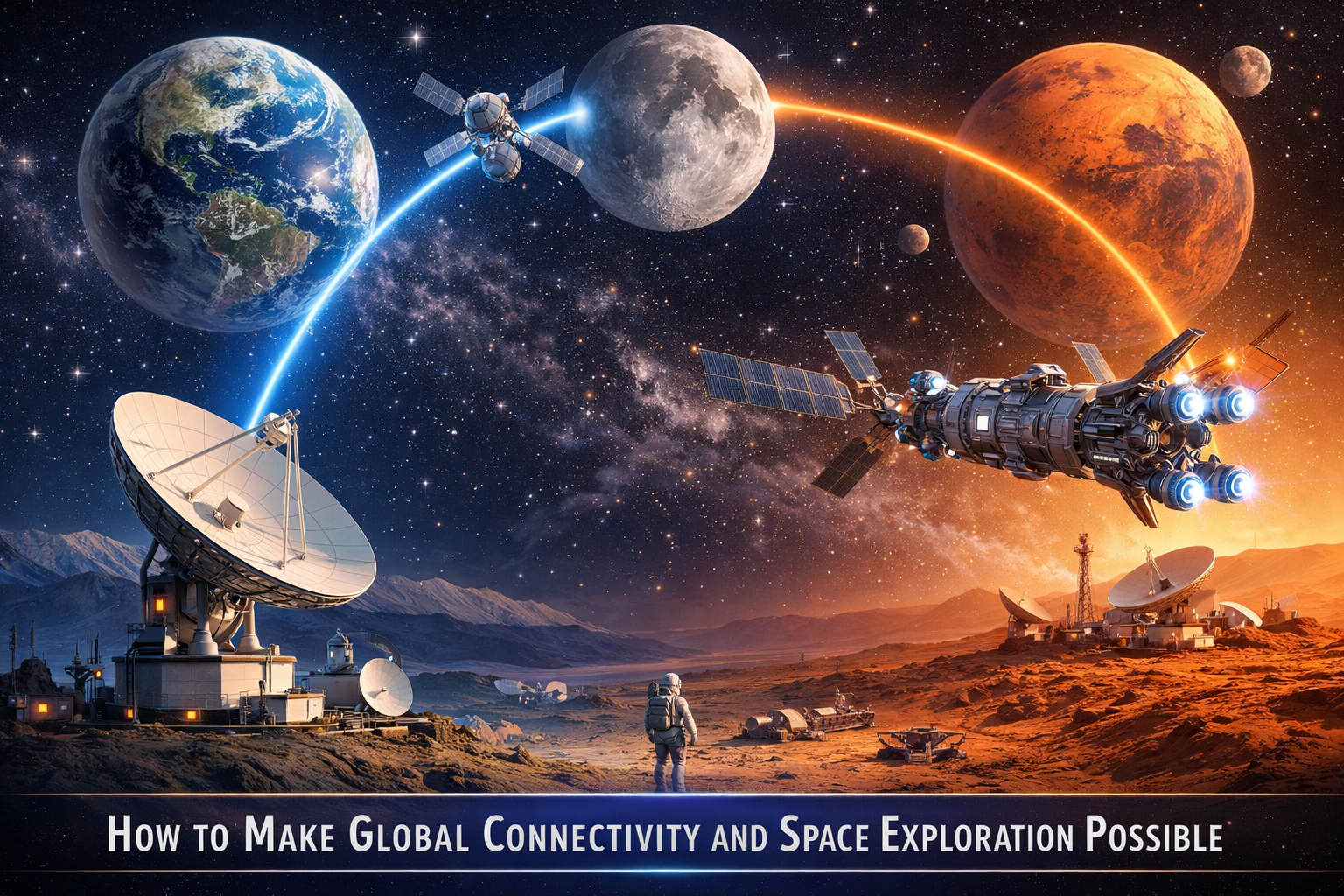
In the rapidly evolving era of global satellite internet and space exploration, the success of ambitious projects depends not only on the satellites orbiting the Earth but also on the infrastructure on the ground-and beyond. Ground control stations on Earth and receiver stations on the Moon and Mars form the invisible backbone that keeps data flowing seamlessly across space. Without these systems, even the most advanced satellite constellations would be unable to deliver reliable internet, manage spacecraft, or support interplanetary communication.
This blog explores the technology, design, and operational strategies behind these stations, showing how they make continuous, high-speed communication across planets possible.
This blog explores the technology, design, and operational strategies behind these stations, showing how they make continuous, high-speed communication across planets possible.
1. The Role of Ground Stations on Earth
Ground stations on Earth are the nerve centers of satellite networks. They are responsible for monitoring, controlling, and optimizing satellite constellations. Each station houses sophisticated antennas, data-processing systems, and AI-driven control software.
Key Functions:
- Satellite Monitoring: Ground stations track satellite positions in real time, ensuring optimal orbital paths and preventing collisions.
- Data Traffic Management: They handle massive data streams, routing internet traffic efficiently while minimizing latency.
- Network Optimization: AI algorithms within ground stations dynamically adjust satellite operations to respond to network demands, weather interference, or orbital changes.
Benefits:
- Continuous connectivity and reliability for users on Earth.
- Reduced downtime for critical space operations.
- Efficient coordination of hundreds or thousands of satellites in large LEO constellations.
For instance, a single ground station in the right location can communicate with multiple satellites simultaneously, acting as both a data relay and a control hub. The system’s redundancy ensures uninterrupted service even if one station experiences issues.
2. Receiver Stations Beyond Earth
Extending connectivity to the Moon and Mars requires specialized receiver stations capable of handling extreme environmental conditions. Unlike Earth stations, these units must operate with minimal human intervention, survive high radiation, extreme temperatures, and low atmospheric pressure, and manage power autonomously.
Key Functions:
- Interplanetary Data Reception: Receiving signals from satellites orbiting Earth or other celestial bodies.
- Earth Communication Relay: Transmitting critical data back to Earth while maintaining continuous communication with local satellites.
- Scientific Support: Facilitating high-speed data transfer for research conducted on the Moon or Mars.
Technical Features:
- Autonomous Systems: Self-operating systems handle monitoring, signal processing, and error correction without constant human oversight.
- Radiation Shielding: Protective materials shield delicate electronics from cosmic rays and solar radiation.
- Solar Power Systems: Solar panels generate energy for continuous operation, supported by batteries or backup nuclear units for periods of darkness or dust storms.
Receiver stations act as the bridge between worlds, allowing astronauts and scientists to send and receive real-time data, conduct experiments, and access global internet services even millions of kilometers from Earth.
3. Continuous Communication Across Distances
The challenge of interplanetary communication lies in distance and latency. Signals traveling between Earth and Mars can take anywhere from 4 to 22 minutes one-way. Ground and receiver stations employ multiple technologies to overcome these obstacles:
- Laser Communication Systems: High-frequency lasers provide faster data transmission and lower latency than traditional radio frequency communication.
- Relay Satellites: Strategically placed satellites act as intermediate relays, maintaining continuous line-of-sight communication between planets.
- AI-Based Error Correction: Automated systems detect and correct data errors caused by cosmic radiation or signal degradation.
These technologies ensure that mission-critical data-like life-support telemetry, scientific research, and internet traffic-flows smoothly across vast distances.
4. Autonomy and Maintenance
Maintenance in remote locations, like the Moon or Mars, is costly and often impossible to perform manually. Receiver stations are designed with autonomous diagnostics, repair, and redundancy.
- Self-Diagnostics: Stations continuously monitor their own health, reporting anomalies to Earth for predictive maintenance.
- Redundant Systems: Critical systems have backups to prevent total failure in case of component malfunction.
- Robotic Maintenance: In some cases, robots or drones can perform repairs or replace modules without human intervention.
This level of autonomy is crucial for long-term missions and ensures that communication remains stable even when Earth-based teams cannot physically intervene.
5. Power Management and Sustainability
Power reliability is a major concern for both Earth-based and extraterrestrial stations. Solar panels are the primary energy source, supplemented by batteries for storage. On Mars, dust storms can reduce sunlight, making backup nuclear energy sources an essential part of station design.
Smart Energy Systems:
- AI-controlled power distribution optimizes energy usage based on operational priorities.
- Solar tracking systems ensure maximum energy absorption.
- Energy-intensive tasks, like high-powered laser transmissions, are scheduled based on available power to maintain efficiency.
These systems allow stations to operate sustainably for long durations without interruption, supporting continuous interplanetary connectivity.
6. Enabling the Future of Global and Interplanetary Internet
By linking Earth, the Moon, and Mars, ground and receiver stations unlock the potential of a truly connected solar system:
- Global Internet Expansion: Even the most remote areas on Earth can benefit from reliable, high-speed internet.
- Scientific Advancement: Continuous communication with lunar and Martian research stations enables real-time data analysis and collaboration.
- Preparation for Colonization: Reliable communication is foundational for long-term habitation, enabling coordination of life-support systems, logistics, and emergency response.
In essence, these stations are not just infrastructure-they are the lifelines of humanity’s future in space.
Conclusion
Ground and receiver stations are the unsung heroes of the space age, ensuring that satellites, spacecraft, and interplanetary missions operate smoothly. By combining AI, autonomous systems, advanced power management, and robust shielding, these stations provide the critical infrastructure needed to support global satellite internet and the first human settlements beyond Earth.
From bridging connectivity gaps on our planet to enabling communication with lunar and Martian outposts, these stations represent a crucial step in humanity’s journey to becoming a multi-planetary species